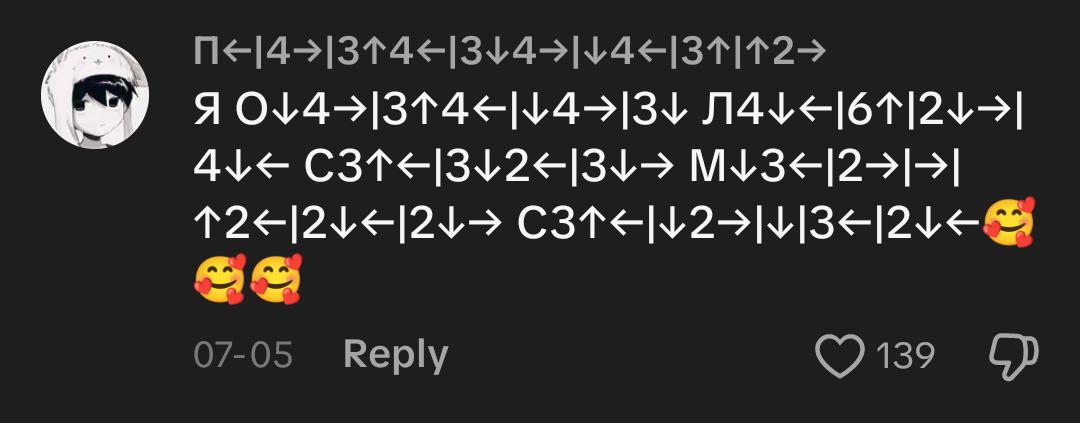
1 · The rules
- Each word starts with its first letter, in plain Cyrillic. That letter is the anchor: where the walk begins.
- Every |-separated chunk is one move to the next letter. Moves are relative to the previous letter, not to a fixed origin.
- A number multiplies the arrow right after it. A bare arrow means 1. So 3↑4← is “up 3, left 4”, and ↓4→ is “down 1, right 4”.
Vertical moves are written before horizontal ones. One step down is +5 places in the alphabet, and one step right is +1, so every move is also just an addition.
Why “number before the arrow”? ↓4→ could be read as ↓1 →4 or as ↓4 →1.
From О, “down 4” falls off the bottom of the grid, so only the first reading works. “Try to break it” in part 3 lets you test this yourself.
The key. Small numbers are alphabet positions (Ё is 7th). Moving down one row adds 5.
2 · Walk a word through the grid
Pick a word, then step through it. The amber ring is the anchor letter. Badges show which step reached each cell. Use the arrow keys to step.
| Step | Chunk | Reads as | Shift | Letter |
|---|
3 · How it was cracked
- Read the shape. Each word is one Cyrillic capital followed only by digits and the four arrows. Spaces split words and bars split chunks. Directions plus counts suggests “turtle” moves on a grid.
- Count the chunks. After their anchors, the words have 4, 4, 3, 6 and 5 moves, so they are 5, 5, 4, 7 and 6 letters long. With a lone Я (“I”) in front, the comment reads as Я О···· Л···· С··· М······· С·····. “Я очень люблю свою …” fits, and the 🥰 emoji suggest affection.
- Find the grid width. If the first word is ОЧЕНЬ, then О→Ч is the 16th letter to the 25th, a gap of 9. The chunk is “down 1, right 4”, which is W + 4 = 9, so the width is 5.
- Test it on everything else. The same grid turns the other words into ЛЮБЛЮ, СВОЮ, МОРСКУЮ and СВИНКУ. All 22 moves in the comment land on a letter, and the endings agree grammatically (свою морскую свинку, all accusative). The display name decodes to real letters too, but ПОТАТУЕВ isn’t a word I recognise. It may be a surname or invented handle.
Try to break it
Change the grid width or the number rule and watch what happens to the comment.
Moves that land on a letter, for every setting (widths 3–10):
4 · Try it yourself
Russian → arrows
Other characters pass through unchanged. A doubled letter (such as ММ) never occurs in the original, so this tool writes it as 0→. That is my own extension.